SITUATION 01
The Discovery Call That Discovered Nothing
“Nice conversation. What did we actually learn about their business?”
Practise questions, follow-up and a clear summary that reveals priorities before the solution enters the conversation.

The demo got applause. The deal went quiet.

Tailored SaaS Sales Training
Illustrative situations for SaaS sales and presales teams. Your programme is shaped around your product, buyers and sales roles.
“Nice conversation. What did we actually learn about their business?”
Practise questions, follow-up and a clear summary that reveals priorities before the solution enters the conversation.
“I can see what it does. Why should that matter to us?”
Connect approved capabilities to a buyer workflow and business priority, then check that the value makes sense to the buyer.
“Your competitor costs less. Can you match them?”
Explore the concern, clarify the comparison and practise a response grounded in approved evidence.
“Why am I explaining our requirements again to your Sales Engineer?”
Rehearse an AE–SE transition that carries the buyer’s context, unresolved questions and the purpose of the technical conversation.
“Finance wants savings. IT wants reassurance. Operations wants less disruption.”
Practise uncovering the different decision criteria and responding to each stakeholder without losing the shared objective.
“Thanks. Send us some information and we’ll be in touch.”
Practise checking what the buyer needs to decide and agreeing a useful next step with an owner and purpose.
Give your sellers a place to sharpen discovery, make the demo relevant and handle the question that changes the room. NewSkilz tailors the scenarios to your proposition, buyer priorities and team roles, with specific feedback and a stronger next attempt.
Your approved product information, sales process and playbook provide the context. We focus on how your team uses that knowledge in buyer conversations.
What people can rehearse
Choose the skills your team needs and practise them around your buyers, proposition and typical deal situations.

Discovery & Listening
Rehearse opening questions, follow-up, listening and summaries. Test assumptions before proposing a solution.
Practice outcome: A clearer account of the buyer’s priorities, constraints and decision criteria.
Presentation & Demo Skills
Build a clear message around a buyer use case. Practise transitions, interruptions and questions while keeping the demo relevant.
Practice outcome: A solution story that connects approved capabilities to what matters to the buyer.
Difficult Buyer Conversations
Practise concerns about fit, risk, price and implementation. Explore the question and use approved evidence or involve the right owner.
Practice outcome: A constructive response and a clear plan for questions needing further validation.
AE–SE Handoffs
Rehearse how commercial and technical colleagues brief each other, introduce specialist input and reconnect to the buyer’s objective.
Practice outcome: A handoff with shared context, clear responsibilities and agreed next steps.
How we work
The strongest feedback starts with evidence from the seller’s real world: what they sell, how your team expects them to sell it and what they actually do when they present.
01 · Align
A short manager conversation plus focused participant and manager needs analysis helps identify the sales moments worth working on. Where useful, relevant KPIs or coaching measures give us another lens on what good performance means in your team.
02 · Bring the real work
Share the sales material you already use: presentation or demo decks, product collateral, approved messaging, playbook guidance and common buyer objections. We use what exists rather than asking your team to manufacture a training brief from scratch.
03 · Show, don’t just tell
For individual coaching, a short pre-session screen recording can show the participant presenting as they normally would. That gives the live session something concrete to work on before valuable coaching time begins.
Then practise
We review the evidence against the agreed development priorities, your approved sales approach and the buyer situation. The live Microsoft Teams session can then concentrate on the moments that matter: rehearse, receive specific feedback and try again.
Full-day and half-day workshops, focused series and individual or small-group rehearsal provide different ways to build the practice into your team’s schedule.
A specialist practice series
The SaaS Sales Pressure Lab puts difficult deal moments under the spotlight through eight one-hour sessions, individually or with a group.
Tailored buyer scenarios, assignments and feedback after every session give sellers repeated attempts and managers a clearer view of coaching priorities.
Explore the SaaS Sales Pressure Lab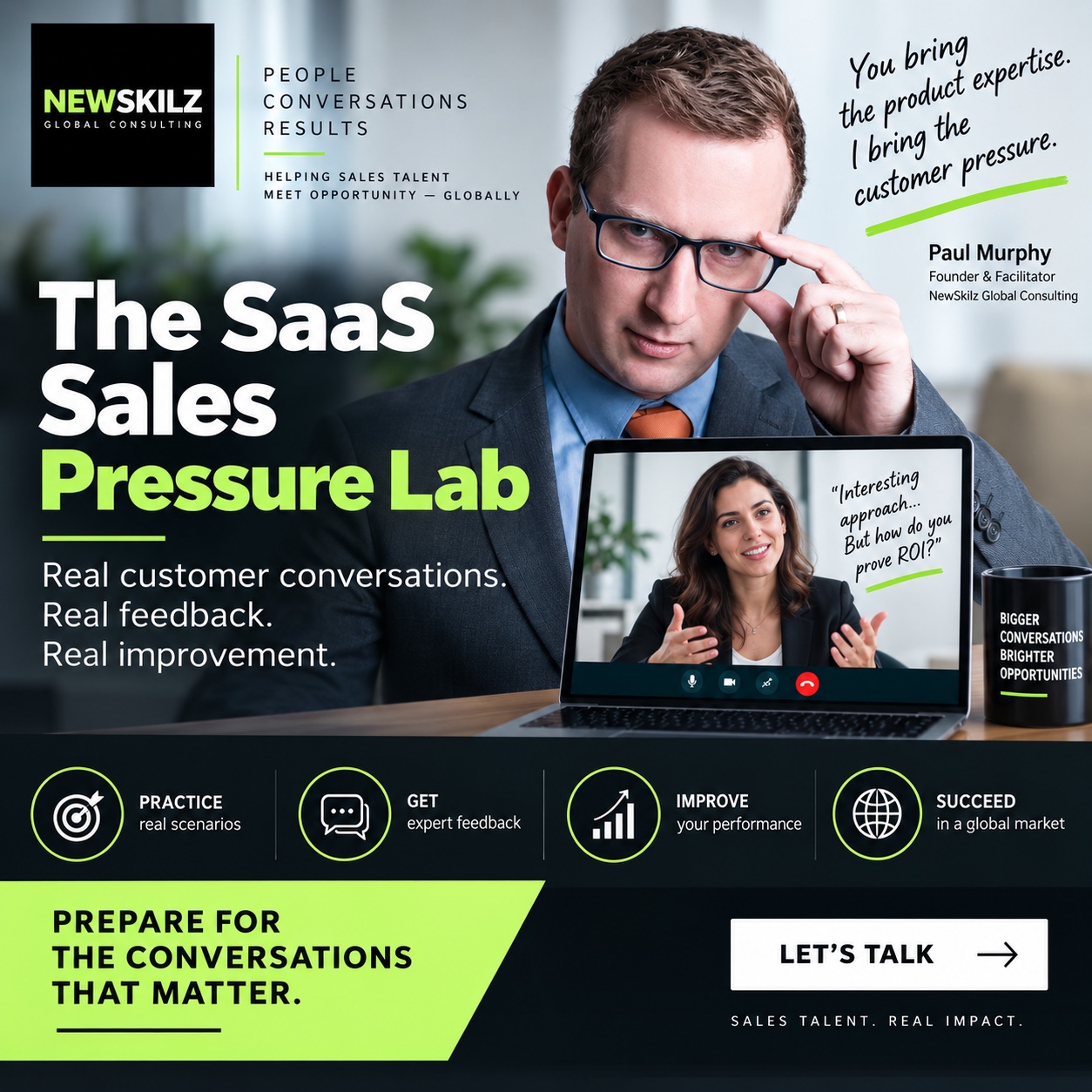
Make the practice last
Agreed feedback tools, practice prompts and action priorities give managers a practical way to revisit the conversations their sellers need to improve.
Where your team will facilitate future sessions, we scope reusable scenarios and Train the Trainer. Bespoke materials can be licensed for agreed internal use; NewSkilz retains its underlying reusable methods, frameworks and tools.
Tell us who is involved, where the conversation gets stuck and what your team needs to handle differently.